
RESEARCH BEHIND THE PRACTICE
Featured researches
Selected publications and research outputs that inform the methods and tools shared here.
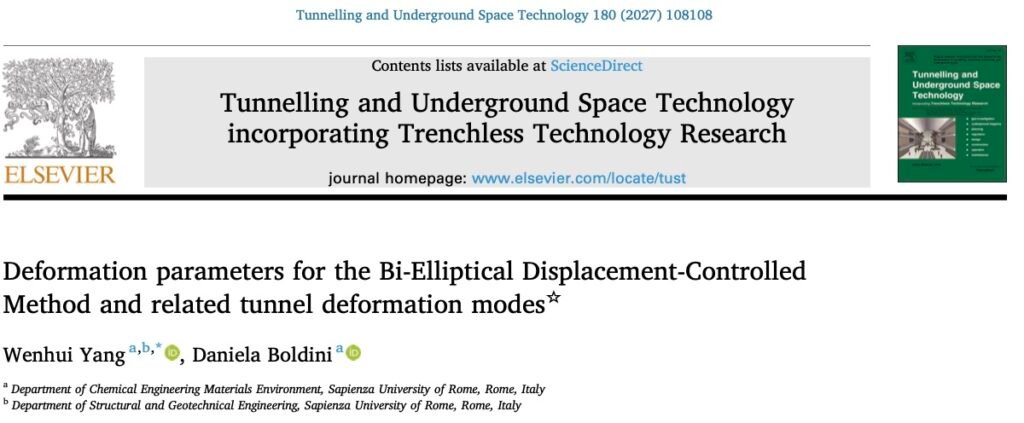
Latest · Yang, W., & Boldini, D. (2027).
🆕Deformation parameters for the Bi-Elliptical Displacement-Controlled Method and related tunnel deformation modes
This study investigates the deformation characteristics of shield tunnel cross-sections using a step-by-step three-dimensional finite element method and proposes recommended parameters for the Bi-Elliptical Displacement-Controlled Method (Bi-Elliptical DCM). The advanced Hardening Soil model with small-strain stiffness was adopted to simulate soil behaviour, and model reliability was validated using the Gaussian settlement trough expression and Kirsch solution. More than 700 numerical cases were analysed considering different soil conditions, tunnel diameters, buried depths, and tunnel volume losses. The results show that tunnel deformation is primarily controlled by soil characteristics, followed by tunnel diameter and buried depth. In coarse-grained soils, tunnel cross-sections exhibit pronounced bi-elliptical deformation, especially for large and deep tunnels, whereas fine-grained soils generally show circular contraction patterns. Based on the numerical results, reference charts for the Bi-Elliptical DCM parameters n1, n2 and β are proposed to enable rapid prediction of tunnelling-induced deformation. The findings improve understanding of shield tunnel deformation mechanisms and provide practical guidance for applying the Bi-Elliptical DCM in engineering projects.
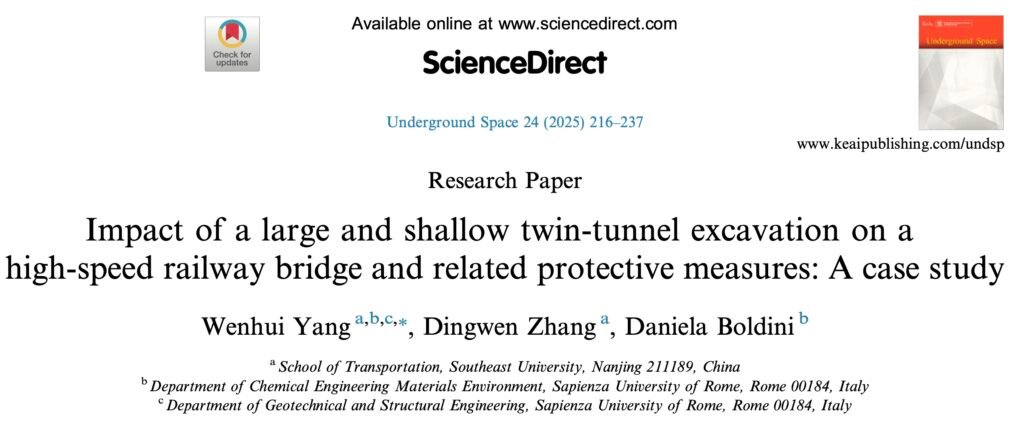
Recommended· Yang, W et al. (2025).
🔥Impact of a large and shallow twin-tunnel excavation on a high-speed railway bridge and related protective measures: A case study
This case study examines a landmark engineering project in Suzhou, China, involving the construction of two large-diameter (13.2 m) shield tunnels beneath an active high-speed railway (HSR) bridge. This pioneering project is the first of its kind in both China and the world. Advanced numerical simulations were conducted to rigorously assess construction risks. To ensure the operational safety of the existing HSR bridge, an innovative protective system, consisting primarily of segmental steel casing concrete pile barriers, was employed. A comprehensive network of monitoring sensors was strategically deployed to track soil, pile barrier, and pier displacements throughout both the protective and tunnelling phases. Simulation results indicated that tunnelling without protective measures could cause pier displacements of up to 3.1 mm along the bridge—exceeding the maximum allowable displacement of 2 mm in accordance with regulations. Monitoring data revealed that the maximum pier displacement during protective scheme installation was limited to 0.5 mm. With these protective measures, pier displacement during each tunnelling phase remained consistently below 0.5 mm, representing an approximate 80% reduction compared to the unprotected scenario, thereby ensuring the continued safety of the HSR bridge.
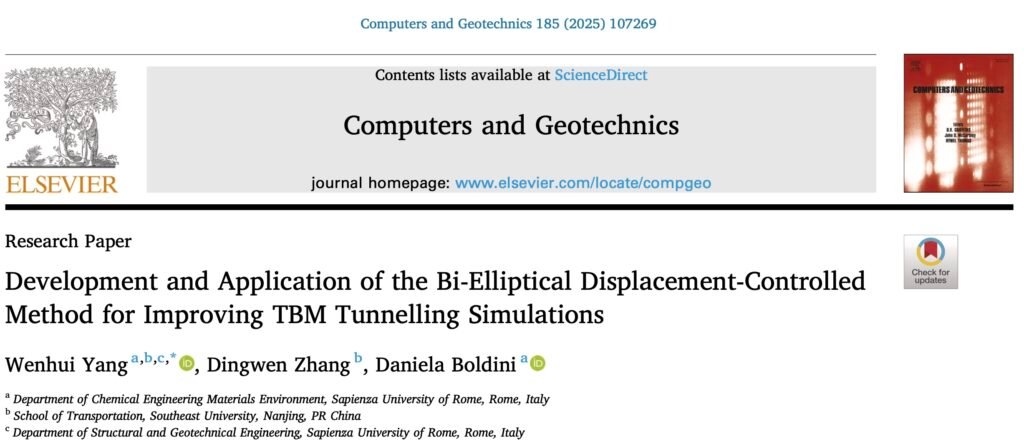
Recommended· Yang, W et al. (2025).
👍🌟Development and Application of the Bi-Elliptical Displacement-Controlled Method for Improving TBM Tunnelling Simulations
The application of a displacement field at the excavation boundary is a widely used numerical technique for the simulation of induced displacements in the case of TBM tunnelling. Typically, a circular displacement pattern is applied without moddelling the lining. However, the effectiveness of this method in simulating the excavation of shallow and large shield tunnels requires further examination. This paper introduces the Bi-Elliptical Displacement-Controlled Method (DCM) for extending the application scope of the Circular DCM and enhancing the accuracy and applicability of DCMs, particularly for shallow large-diameter tunnels. This method, developed on the basis of theoretical assumptions and verified by three-dimensional finite element analyses, assumes a new displacement pattern characterized by independent elliptical contractions for the upper and lower sections of the tunnel, while also accounting for its overall vertical translation. The deformed tunnel profile is controlled by three deformation parameters, functions of the tunnel geometry, excavation conditions, and soil properties. Two Python-based automation tools for Plaxis 3D were developed and described in detail to aid in the calibration of deformation parameters and efficient application of the method. The method and tools were validated through their applications to back-analyse a large and shallow tunnel excavation both in free-field conditions and below a high-speed railway bridge. This approach holds considerable potential for applications in information-based construction and real-time Design-Build processes.
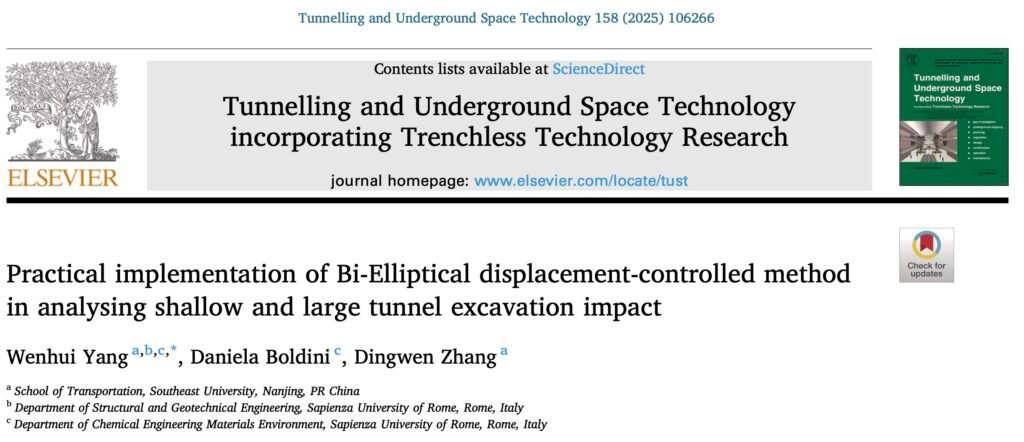
Latest · Yang, W., & Boldini, D. (2027).
👍🌟Practical implementation of Bi-Elliptical displacement-controlled method in analysing shallow and large tunnel excavation impact
This study investigates the deformation characteristics of shield tunnel cross-sections using a step-by-step three-dimensional finite element method and proposes recommended parameters for the Bi-Elliptical Displacement-Controlled Method (Bi-Elliptical DCM). The advanced Hardening Soil model with small-strain stiffness was adopted to simulate soil behaviour, and model reliability was validated using the Gaussian settlement trough expression and Kirsch solution. More than 700 numerical cases were analysed considering different soil conditions, tunnel diameters, buried depths, and tunnel volume losses. The results show that tunnel deformation is primarily controlled by soil characteristics, followed by tunnel diameter and buried depth. In coarse-grained soils, tunnel cross-sections exhibit pronounced bi-elliptical deformation, especially for large and deep tunnels, whereas fine-grained soils generally show circular contraction patterns. Based on the numerical results, reference charts for the Bi-Elliptical DCM parameters n1, n2 and β are proposed to enable rapid prediction of tunnelling-induced deformation. The findings improve understanding of shield tunnel deformation mechanisms and provide practical guidance for applying the Bi-Elliptical DCM in engineering projects.
Recommended· Yang, W et al. (2022).
🔥Field measurement analysis of the influence of simultaneous construction of river channel and bridge on existing double shield tunnels
This case study examines a landmark engineering project in Suzhou, China, involving the construction of two large-diameter (13.2 m) shield tunnels beneath an active high-speed railway (HSR) bridge. This pioneering project is the first of its kind in both China and the world. Advanced numerical simulations were conducted to rigorously assess construction risks. To ensure the operational safety of the existing HSR bridge, an innovative protective system, consisting primarily of segmental steel casing concrete pile barriers, was employed. A comprehensive network of monitoring sensors was strategically deployed to track soil, pile barrier, and pier displacements throughout both the protective and tunnelling phases. Simulation results indicated that tunnelling without protective measures could cause pier displacements of up to 3.1 mm along the bridge—exceeding the maximum allowable displacement of 2 mm in accordance with regulations. Monitoring data revealed that the maximum pier displacement during protective scheme installation was limited to 0.5 mm. With these protective measures, pier displacement during each tunnelling phase remained consistently below 0.5 mm, representing an approximate 80% reduction compared to the unprotected scenario, thereby ensuring the continued safety of the HSR bridge.
Explore More
More things you can try.
Learn finite element modeling, perform geotechnical calculations, automate engineering workflows, and explore research-driven solutions.
Automate
Downloadable scripts and tools for more efficient, repeatable workflows.